
A Bioblitz is a hands-on biodiversity survey where experts and semi-professional participants explore a specific area together for a set period of time, recording every species they can observe. Most Bioblitzes are completed within 24 hours, helping to reveal local biodiversity and highlight why conserving it matters.
Since it began in 1996 at the Kenilworth Aquatic Gardens in Washington, D.C., Bioblitz has spread around the world and grown into a global biodiversity event held regularly in many countries. As a leading citizen-science program, Bioblitz helps raise public interest in biodiversity and invites people to take part in real scientific exploration.
Participants, guided by experts, discover the hidden value of local ecosystems by observing and recording a wide variety of species and sharing what they find. These efforts not only strengthen biodiversity conservation and ecosystem management, but also help people truly appreciate how precious nature and its living resources are. As global warming and urbanization accelerate biodiversity loss, Bioblitz offers an important opportunity to build a more sustainable relationship between humans and nature.
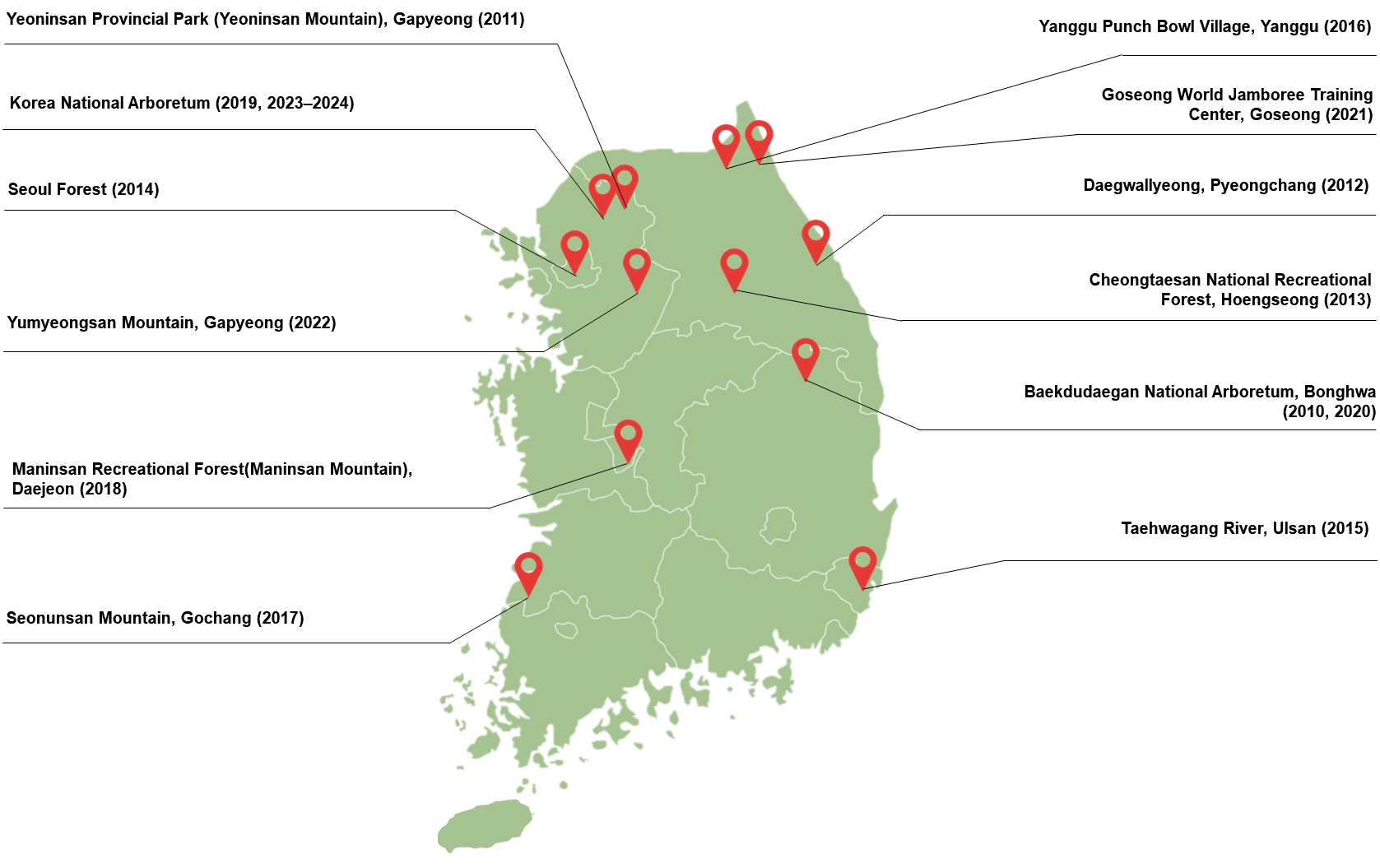
Korea’s first Bioblitz was held in 2010 by the Korea National Arboretum of the Korea Forest Service at the planned Baekdu-daegan National Arboretum site. Today, Bioblitz continues every year in many regions across the country. Participants gather biodiversity data together and, through a meaningful connection with nature, deepen their understanding of conservation and put shared responsibility into action.
| Program | Content |
| Semi-professional Survey | This is a field survey program in which semi-professional participants investigate assigned areas without prior on-site training from experts. The group is made up of semi-professionals with experience in ecological surveys, and participants spend about 2~3 hours in a single day surveying all five taxonomic groups (plants, insects, fungi, bryophytes, and mammals). All observed species are recorded using iNaturalist. If a species can’t be identified on site or appears to be misidentified, participants get support from on-site experts or consult taxonomic specialists through iNaturalist for re-identification. By directly contributing to the survey records, participants help protect local biodiversity. |
| Walk Program | This program offers species exploration, ecological observation, and biodiversity education along a designated route or at designated sites. Direct interaction with experts helps participants deepen their understanding of biodiversity. |
| Talk Concert | This is an open dialogue session where experts present stories and insights about biodiversity, followed by free discussion with participants. Through expert knowledge and engaging accounts from the survey process, participants broaden their understanding of nature and deepen their appreciation of the natural world. |
| Special Program | This expert-led program is conducted at dawn or at night. Semi-professional participants work with experts to follow designated routes or inspect pre-installed traps, observing and experiencing birds and insects in the field. |
| Group | Content |
| Experts | The expert team plays a pivotal role in Bioblitz. With expertise in plants, animals, insects, and other taxa, they collect accurate, reliable data through hands-on field observation and documentation. |
| Semi-professionals | Semi-professionals are citizen participants with foundational biological knowledge. Working closely with experts, they survey and record species, and help review findings to improve data accuracy. As future leaders of biodiversity exploration in Korea, they are expected to play a growing role in conservation. |